Scaffold · AI for product strategy
Knowing what to build has never been so important. And you’ve never had so little time to come up with a robust strategy.
You’re busier than ever, whether you’re the only product manager in a small team or one of many across several product teams. You spend a minimum of 50 hours a week at work. Scaffold helps you make better product decisions, and get better at making them.
You decide what gets built, and you need to defend your choices.
You need to articulate a robust product strategy, and defend the roadmap that delivers it.
You know there are a number of different techniques that can help. But because product management is taught by apprenticeship, it takes a while to understand what to use where.
Every request takes the product in a different direction.
You often feel overwhelmed by the sheer volume of feature options you’re facing: direct requests from sales and marketing, requests from customers, and direct asks from the CEO.
This was always hard. But now that engineers are using AI, the pace has increased almost exponentially. You feel frustrated, sometimes almost to the point of burning out.
- Salesdirect request
- Marketingdirect request
- Customersrequests
- The CEOdirect ask
Analysis paralysis, or prioritising by decibel.
Choices are often made on a hunch, rather than on solid insight.
You alternate between the two: analysing without deciding, or prioritising whoever shouts the loudest. Neither leads to a coherent product making significant headway in the strategic direction that was decided.
Without solving this, you face intervention from leadership to take over the direction, which leaves you completely disempowered.
It’s not only the future of the product that is at stake, but also your future career.
Enter Scaffold
With Scaffold, you get to a product strategy you can defend, without the 50-hour weeks.
Instead of haphazardly trying different product management models, Scaffold provides an approach that gradually builds a precise picture of where the product should go.
It does so very effectively and efficiently, because each piece of insight is then used to move the thinking forward.
You never start from a blank page.
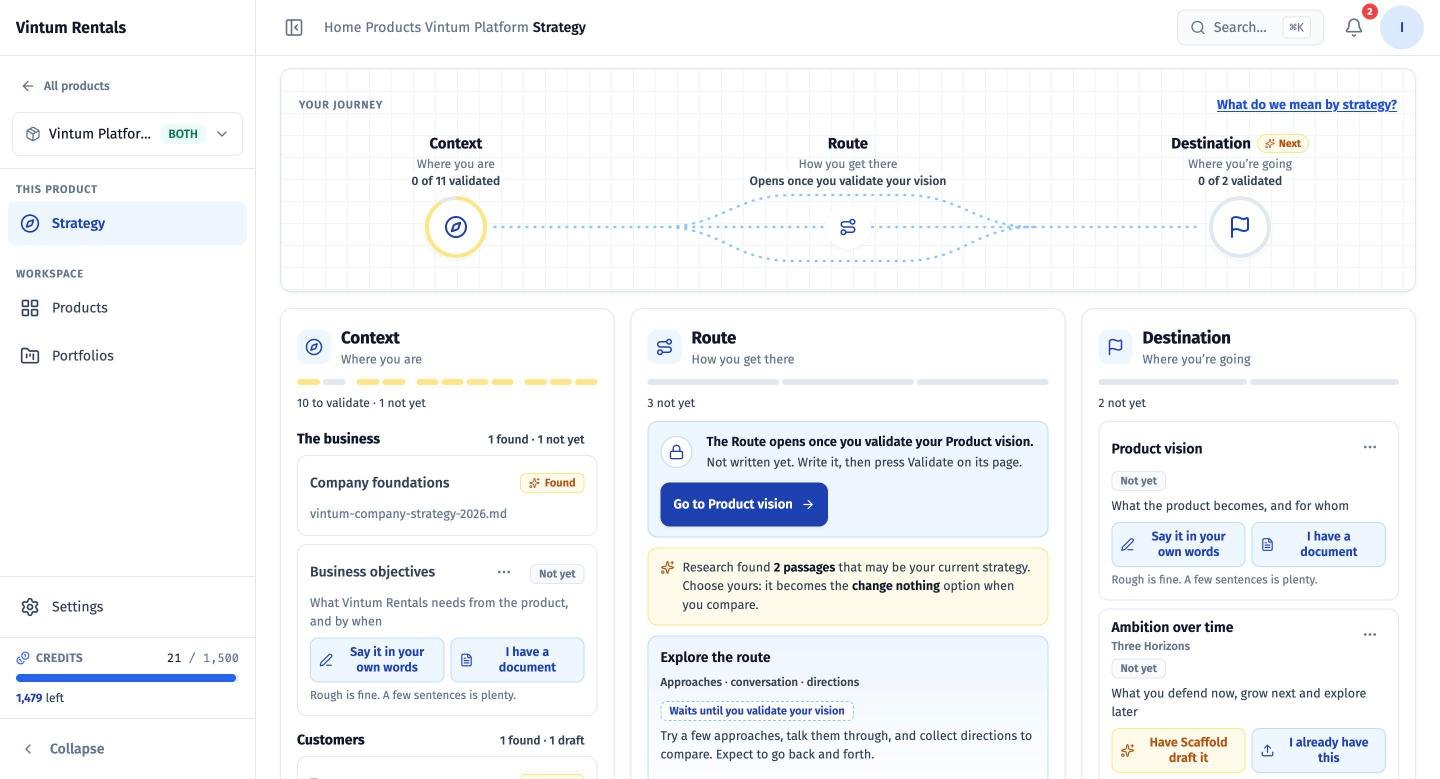
Paste a link and drop in the documents you already have. Scaffold finds what your company has already decided, drafts what research can support, and emails you when your starting point is ready. You get on with your day.
You see the real options, including changing nothing.
Scaffold suggests the approaches that suit your product's stage, such as Growth Paths or How You Compete, and lets you combine them and talk them through. Every direction is compared with the strategy you have today, so the choice is a real one.
You walk into the room able to defend it.
You choose, in your own words, and validate. What you take to your CEO is a strategy narrative and roadmap themes, with the reasoning and the sources behind every choice.
Scaffold can find a choice in your material. It never invents one: only you can validate your strategy. See how it works
Twenty years of product management experience, in a small package.
Anyone can hand you a Business Case template. Knowing it is not worth writing until you have a market size and a pricing model, and saying so before you waste the afternoon, is the part that takes twenty years.
Business Case → Product Vision · TAM / SAM / SOM · Pricing Models · Performance Metrics · +6 more
The method comes from Cyril Le Roux, who teaches Product Focus's flagship product management course and co-authored their AI course. He learned it doing the job: senior product leader at BT, Photobox, Zoopla and TransferGo, consultant to Companial, Puzzel and Holafly.
And what it is not: Scaffold owns the judgement, never the backlog. It records decisions and the reasoning behind them; it does not track delivery, so no sprints, no statuses, no code generation and no OKR tracking. That stays in Linear or Jira.
One product, from a link to a strategy.
Vintum is a fictional company that rents furnished homes in Lisbon to people on work assignments. The company is invented; the screens are the real product.
The product is more successful. And so is your career.
You’re now capable of articulating and defending a strong product strategy. In the process, you learn about all the different ingredients that need to be taken into consideration.
- Faster decisions
- You make product decisions much quicker.
- The right context for engineering
- You give the engineering team the right context to build the product the best way possible.
- Time at the strategic level
- You get more time to interact with stakeholders and engage at a strategic level, which raises your visibility in the organisation.
Start with what your company already knows.
Paste your product's link and Scaffold drafts your starting point. Your data is stored in the EU; the AI runs through US providers. How your data is handled.