How Scaffold works
From a link to a product strategy you can defend.
Scaffold does the legwork; you make the calls. It finds what your material already says, drafts what research can support, and leaves every choice to you.
Your strategy, drawn as a voyage.
Every product gets a strategy map in three parts. Context and destination need little debate; the route is where the thinking happens.
- 1
Context
Where you are
- Company Foundations
- Persona
- PEST Analysis
- Competitor Profiles
- Porter's Five Forces
- Value Proposition Canvas
- 2
Route
How you get there
- Strategic Options
- Strategy Narrative ("The Trip")
- Now, Next, Later
- 3
Destination
Where you're going
- Product Vision
- 3 Horizons
Context
Follow Vintum from a link to a strategy map.
Vintum is a fictional company that rents furnished homes in Lisbon to people on work assignments. The company is invented; the screens are the real product.
- 1
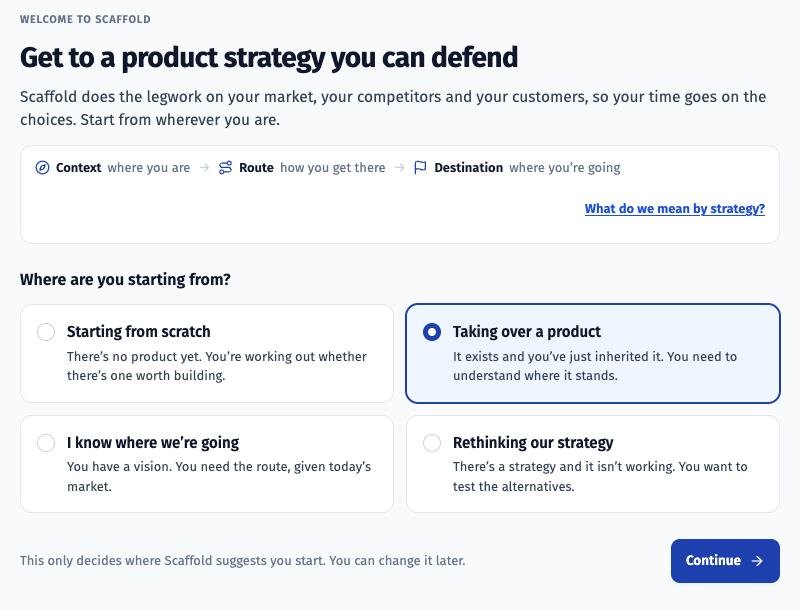
Say where you're starting from.
Starting from scratch, taking over a product, knowing where you're going, or rethinking a strategy that isn't working. Vintum's product manager has just taken over the platform. The answer only decides where Scaffold suggests you start, and you can change it later.
- 2
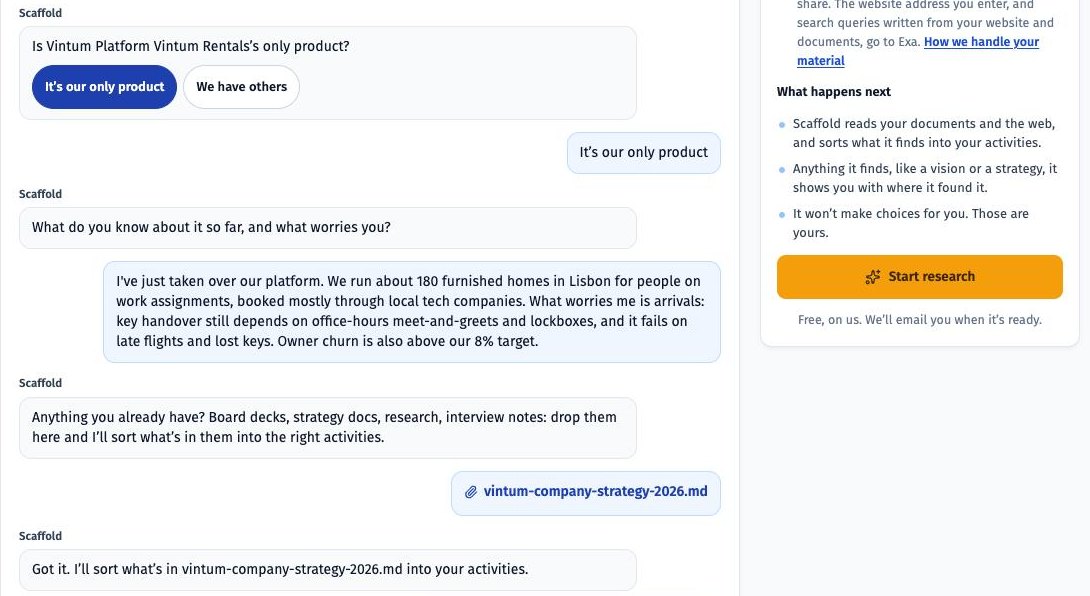
Tell it about your product.
Paste your product's link, or say there isn't one. Scaffold asks what you know so far and what worries you, then asks for anything you already have: a board deck, a strategy doc, customer interviews. Scaffold infers your product's stage, and you confirm it.
- 3
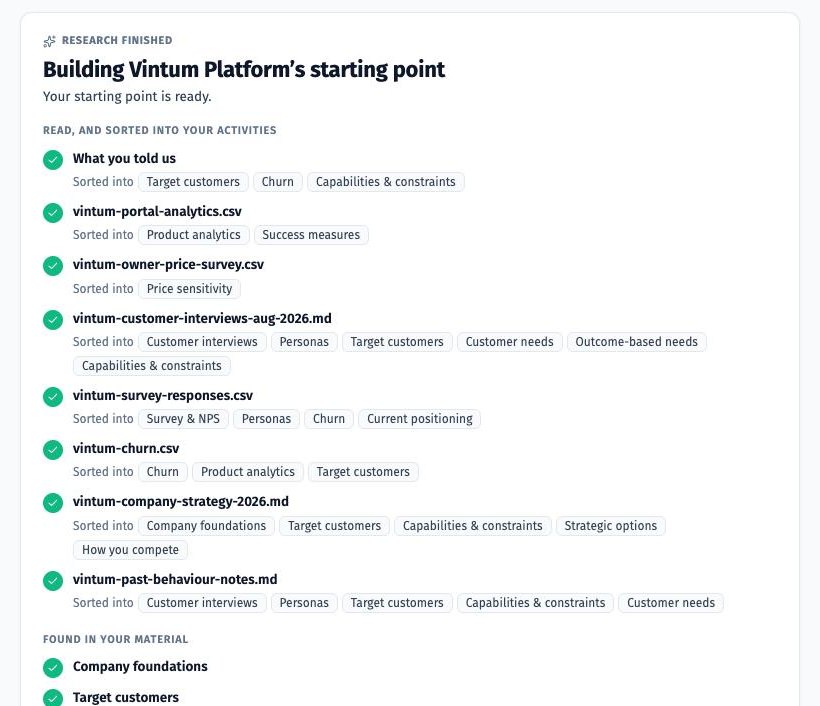
Scaffold does the legwork.
A free research run reads your website and documents and sorts each one into the activities it informs. It quotes what it finds in your material, with the source, and drafts what research can support: your market, your competitors, your customers. It runs in the background and emails you when your starting point is ready.
- 4
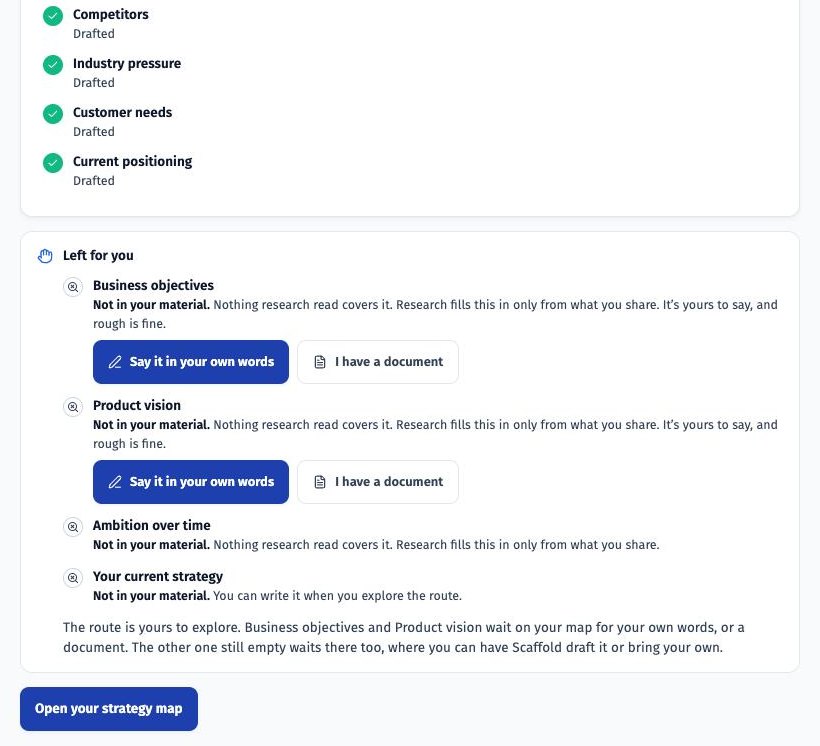
What's left is yours.
It can find a choice; it never invents one. Your business objectives and your product vision come only from what you share: say them in your own words, or bring a document. Rough is fine.
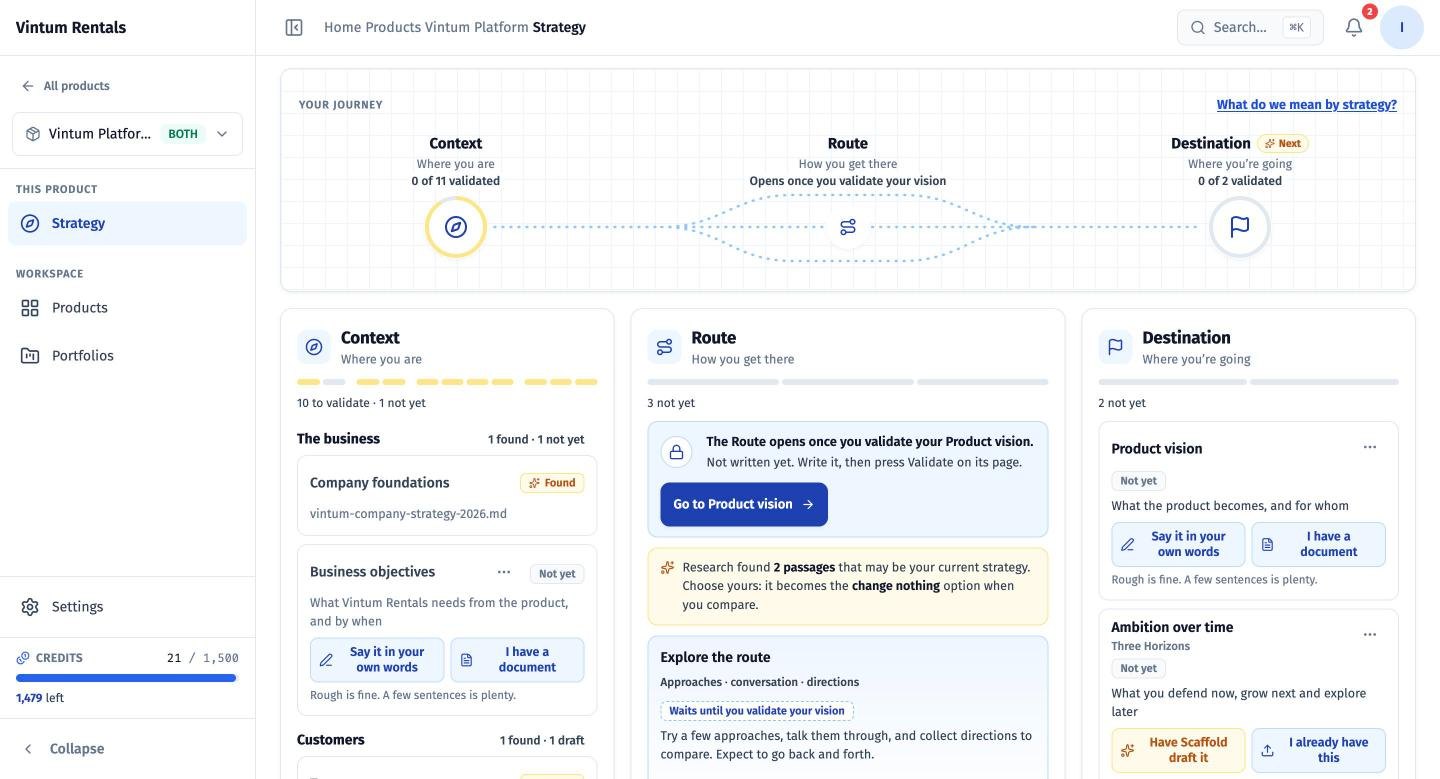
Everything lands on your strategy map.
Context, route and destination, side by side. Vintum's context is nearly complete, each piece found in its own documents or drafted from research. Where research can help, you choose: have Scaffold draft it, or bring your own. The route opens once you validate your product vision.
You always know who wrote what.
- Found
- Quoted from your own material, with its source.
- Draft
- Drafted by Scaffold from research.
- Validated
- Checked by you and made yours. Only you can set it.
Route
See the real options before you choose.
Once you validate your product vision, Scaffold suggests at most two approaches that suit your product's stage, with the reason for each. Run the ones you want, combine two into one direction, for example where to grow with how to stand out, and talk it through in the chat beside the map. The chat helps you think, and it can propose a direction for you to keep or drop.
BCG Matrix
Position your products or features on a growth-share matrix.
Uncontested Market Strategy
Create new uncontested market space via value innovation: a strategy canvas of competing factors plus an Eliminate-Reduce-Raise-Create grid.
Zone to Win
Decide where to compete hard and where not to — concentration of effort.
Growth Paths
Ansoff matrix: where your next growth comes from — more of the same, new markets, new products, or both — and which paths are worth comparing.
How You Compete
Porter's generic strategies: whether you win on lower cost or on a different offer, across the whole market or one niche, and where you stand today.
Decide, and be able to defend it.
Strategic Options puts the directions you kept side by side with changing nothing, on the same evidence. You choose, and write why in your own words. Then you validate the strategy narrative and your Now, Next, Later themes.
Destination
Know where you're going.
The destination is Product Vision and 3 Horizons: what your product will become and who it serves, and how its growth bets split across the near, mid and long term. Like everything on the map, it stays a draft until you validate it in your own words.
Once your strategy is validated, Bets opens: evaluate one idea at a time against it.
Share it before it's finished
Export at any stage. Drafts are marked as drafts, so you can share the context before the route is decided.
When things change
Change something you validated and Scaffold flags the activities that read it directly, so you know what to revisit.
What it changes about the job.
You can build, present and execute a robust product strategy, and defend the roadmap that delivers it.
Defend every choice. Six weeks later, you can still show your working.
Every part of your strategy shows where it came from: found in your own material, with its source, drafted by Scaffold from research, or validated by you.
A robust strategy, without the 50-hour weeks
The research and first drafts are done for you, so your hours go into deciding.
Decide on insight, not decibels
When sales, customers and the CEO each pull a different way, the evidence for the direction is already in your strategy map.
Learn the craft as you go
You work through the techniques in an order that makes sense, and learn all the ingredients a strategy needs along the way.
Give engineering the right context
Decisions arrive with the reasoning behind them, so the team can build the product the best way possible.
Guides on product strategy.
Product strategy, prioritisation and the tools around them, written for the product manager who has to decide what gets built and defend it.
Read the guidesStart with what your company already knows.
Your data is stored in the EU; the AI runs through US providers. How your data is handled.